
The Homestead Act: An Overview
The Homestead Act of 1862 was a landmark legislation in the history of the United States, primarily aimed at encouraging the settlement and development of its Western territories. By offering 160 acres of public land, the Act provided an unprecedented opportunity for individuals willing to establish a homestead and improve the land. This development occurred at little to no direct cost to settlers, contingent upon the condition that they would engage in activities such as building a home and cultivating the land for a period of five years. The overarching aim was to stimulate westward expansion, a key objective of the nation during that era.
Legislative Background
The passage of the Homestead Act came after years of debate and political maneuvering in Congress. Before the Civil War, the proposal for free land distribution had been contentious, rooted in the economic and political interests of different states. The Southern states, in particular, opposed the idea, fearing it would lead to the creation of more free states and upset the balance of power. However, with the secession of the Southern states during the Civil War, the path was cleared for the implementation of the Act. Signed into law by President Abraham Lincoln on May 20, 1862, the Act marked a transformative moment in American policy.
Implementation and Eligibility
The Homestead Act invited a wide array of participants, including immigrants, freed slaves, and women. Essentially, anyone over the age of 21 or head of a family qualified to file an application, provided they had not taken up arms against the United States. This inclusivity extended opportunities to various demographics, facilitating a diverse settlement pattern in the American Midwest and West.
The Process and Challenges
Once an application was filed, claimants had to improve and cultivate the land, a requirement that presented several challenges. The initial obstacles of harsh weather conditions, isolation, and limited resources made survival and success difficult for many settlers. Despite these adversities, by the end of the Act’s influence, millions of acres of land were successfully settled and developed, playing an essential role in America’s agrarian and economic development.
Impact on Native Lands
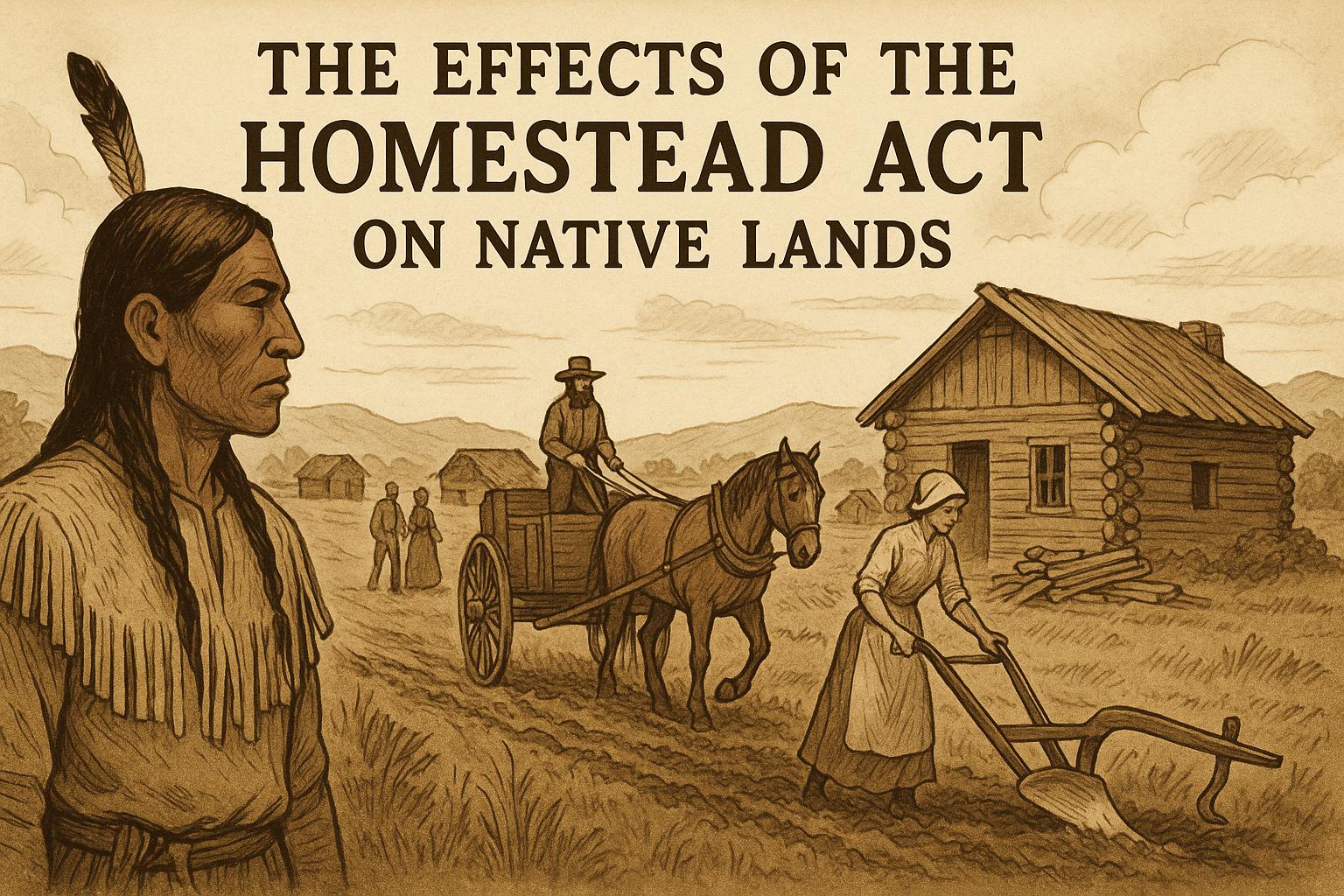
The implications of the Homestead Act were extensive, particularly concerning Native American lands. Prior to the enactment of the legislation, expansive tracts of these lands were inhabited by Native tribes, integral to their livelihoods and cultures. The introduction of the Act catalyzed the systematic division and allocation of these lands to new settlers, fundamentally altering the Indigenous presence and their way of life in these regions.
Displacement of Native Tribes
The migration facilitated by the Homestead Act precipitated a wave of displacement for countless Native tribes. As settlers moved westward in search of new opportunities, they frequently encroached upon Indigenous territories traditionally occupied by Native communities. This encroachment was often accompanied by forced relocation, either through unofficial means or as a result of governmental treaties and policies designed to expedite settlement and development. Consequently, native tribes were displaced from their ancestral lands and compelled to seek new areas for settlement, fundamentally altering their existence.
Loss of Resources
Homesteaders brought agricultural practices that led to environmental transformations, such as widespread deforestation and soil degradation. Native tribes, who relied heavily on these environments for their hunting, gathering, and cultural practices, found their resources increasingly contested and altered. As a result, Native communities faced severe challenges in maintaining their traditional lifestyles. The ensuing competition for scarce resources frequently resulted in disputes between settlers and Native Americans, underpinning a fraught relationship marked by conflict.
Cultural Implications
Apart from the physical displacement experienced by Native tribes, the effects of the Homestead Act extended deeply into the realm of Native culture and community structures. Forced relocations disrupted tribal sovereignty and traditional ways of life, impacting language, rituals, and social organization. The introduction of the reservation system further compartmentalized Native life, often severing cultural and historical connections to the land. Over time, this disconnection eroded cultural continuity, with lasting effects on subsequent generations.
Impacts on American Society
Beyond its influence on Native American lives, the Homestead Act played an integral role in shaping broader American society. The Act promoted an ethos of self-reliance and hard work, values that would become deeply embedded in American culture. As homesteaders transformed the landscape into productive farms and settlements, economic growth followed, with the expansion of agriculture leading to increased food production and trade.
Creation of New Communities
The influx of settlers and the establishment of homesteads gave rise to new communities and towns. These emerging settlements became the backbone of the rural American landscape, fostering social networks and collective identities that persist today.
Advancements in Infrastructure
The need to support these new settlements spurred advancements in infrastructure, with roads, railroads, and communication networks developing rapidly to connect distant areas to the rest of the country. This expansion facilitated greater mobility and economic interaction, further integrating the nation’s economy.
Legislative Legacy
While the Homestead Act was eventually repealed in the 1970s, its legacy remains a subject of study and reflection. Historically, it represents an era where the United States prioritized agricultural expansion and settlement. However, its repercussions, particularly on Native American communities, underpin ongoing discussions about land rights, cultural heritage, and historical justice.
In conclusion, while the Homestead Act was instrumental in accelerating the settlement and economic growth of the United States, it also led to significant hardships for Native American populations. Its implementation resulted in displacement, cultural erosion, and conflict over land and resources. The Act’s legacy is a multifaceted trajectory of opportunity for some and profound challenges for others. For those interested in exploring these themes further, numerous educational resources delve into the deep-seated impacts of U.S. legislative measures on Native American history.