
Marguerite-Magdelaine La Framboise (1780-1846), also known as Madeline La Framboise, was one of the most successful fur traders in the Northwest Territory of the United States. She was of Odawa and French descent, and spoke the French, English, Odawa and Ojibwe languages fluently.
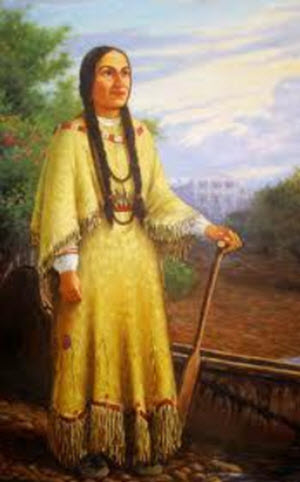
She retired from the fur trade in her early 40s, after selling her flourishing busines for a large amount of money. Afterwards, she started a school for Native American children on Mackinac Island, and also supproted Sunday School and other activities at Sainte Anne Church.
The house that La Framboise had built on the island is still standing – it is now the Harbour View Inn. Next to the house is Saint Anne’s Church, built on land donated by La Framboise.
La Frambois lived in what is now western Michigan, and she has been a part of The Michigan Women’s Hall of Fame since 1984.
Personal information
Childhood
Marguerite-Magdelaine Marcot was born in Fort St. Joseph, Michigan, in February 1780 or 1781. She was the youngest of seven children born to the French fur trader Jean Baptiste Marcot (1720–1783) and the Odawa woman Marie Nekesh (c.1740 – c.1790). Marie was also known as Marianne Amighissen, and she was the daughter of Chief Kewinoquot.
In 1783, Jean Baptiste Marcot was killed. When he was still alive, he had sent his children to be educated in Montreal when they got old enough, but after his death Marie could not afford to do this. After the British abandoned Fort St. Joseph, Marie moved with her children to Mackinac.
Marguerite-Magdelaine was baptised together with her sister Therese by a Roman Catholic priest on Mackinac Island on 1 August, 1786.
With her youngest daughters, Marie Nekesh lived by the mouth of the Grand River on the eastern shore of Lake Michigan, in an area that we today know as Grand Haven. Back then, it was a Lac Courtes Oreilles village, and the river was an important trade route into the interior of Michigan. After living here, both Therese and Marguerite-Magdelaine were fluent in not just French and Odawa, but also English and Chippewa (Ojibwe).
Marriage and children
In 1794, the young Marguerite-Magdelaine married Joseph La Framboise (1765-1806). The couple was married by Odawa custom, which back then was known as ”the custom of the coutry”.
Their first child, Josette La Framboise (1795-1820), was born on 24 September 1795. Their son Joseph La Framboise (1805-1856) was born in March 1805. With the money from her successful fur trade business, Marguerite-Magdelaine could afford to eventually send both her children to Montreal to be educated in French schools.
On 11 July, 1804, the couple had their marriage solemnized by a Catholic missionary at Mackinac Island.
Fur trading
Beginnings

Together with her husband Joseph, Madeline established trading posts in the Grand River Valley of west Michigan.
Every fall, the couple would bring trade goods to buy furs from the Ottowa from Mackinac Island down to the Grand River area, and every spring they returned with the furs they had bought. She acted as an arbitrage trader benefitting from the lower value of fur in the rural areas and the lower value of other trade goods in the city. This allowed her to benefit twice on each trade.
Eventually, the La Framboises created the first permanent mercantile building in the west Michigan area, and it developed into what we today know as Fallasburg.
Madeline wasn’t the only woman in the fur trade on Mackinac; her sister Therese was a fur trader too. Therese had moved to Mackinac in 1805 with her husband George Schindler and daughter Marianne, settling down not far from where the La Framboises lived.
Expansion
In 1806, when Madeline La Framboise was 26 years old, her husband was murdered, and the full responsability of the fur trade enterprise and caring for the family fell on her. Not only did she continue to manage the trading posts, but she also expanded the business westward and northward on Michigan’s norhern peninsula.
In an era where an experienced fur trader could expect to make around $1,000 per year (which was a large sum at the time), La Framboise made $5,000 to $10,000 per year. La Framboise spoke several languages and had cultivated a strong network among the Native American fur trappers, which gave her an edge in the competition against other fur traders.
In the book ”A Snug Little Place/ Memories of Ada Michigan 1821 – 1930”, Madeline La Framboise is mentioned.
- “La Framboise, the half-Ottawa wife of a murdered French trapper, owned a string of trading posts in the Grand River Valley. Reputed to be no ordinary woman — probably for succeeding in an exclusively male trade in the “pays d’en haut” or savage country.”
After competing successfully against John Jacob Astor’s American Fur Company for many years, she decided to become an affiliate instead in 1818. In 1822 she sold her business to him for a large sum of money and retired to Mackinac Island.
Life after retiring from the fur trade
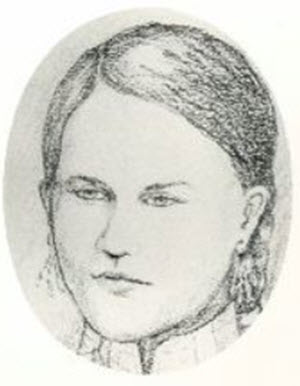
After selling her business, La Framboise was a wealthy woman, and she had a stately home built on Mackinac Island. The construction was managed by her son-in-law Captain Benjamin Pierce, commandant of Fort Mackinac.
Now with more time on her hands, La Framboise taught herself to read and write and both French and English. She also started a Catholic school for Native American children on the island, housing it in her own home.
Her devotion to Saint Anne’s Church helped keep the island congregation together for several years when there was no regular priest. The parish register lists her as the godmother for many baptisms and witness to many marriage ceremonies. Eventually, La Frambois donated the property next to her home to erect a new churchbuilding on.
In the 1830s and 1840s, La Framboise hosted many prominent visitors, including the writers Sarah Margarat Fuller and Alexis de Tocqueville. Fuller eventually wrote about the visit in her book Summer on the Lakes, where she describes La Framboise as ”… the widow of a French trader, an Indian by birth, and wearing the dress of her country. She spoke French fluently, and was very ladylike in her manners. She is a great character among them. They were all the time coming to pay her homage, or to get her aid and advice; for she is, I am told, a shrewd woman of business.”
Death
Death
La Framboise died on 14 April, 1846. According to her own wishes, she was interred beneath the altar of Saint Anne’s Church on the island. In the 1960s, her body – as well as the remains of her daughter Josephin and her granddaughter Josette – were moved to the churchyard. In the early 21
st century, a crypt was built for prayer and internments, and the remains of the La Framboise family was reinterred there on 26 July, 2013. Some of Madeline Framboise’s descendants were present at the reinterment ceremony.
Timeline of her life
Marguerite-Magdelaine La Framboise Timeline
A chronological look at the life, fur-trading career and later community work of one of the most notable businesswomen of the early Great Lakes region.
Birth
Marguerite-Magdelaine Marcot, later known as Madame La Framboise, was born in the upper Great Lakes region. Her exact birthplace is uncertain, although her family was living at Fort St. Joseph, near present-day Niles, Michigan, by June 1780. Her father, Jean-Baptiste Marcot, was a French fur trader, while her mother, Marie Neskech, was the daughter of an Odawa chief.
Her Father Is Killed
When Magdelaine was about three years old, her father was killed. Her mother subsequently returned with the family to her Native community near the mouth of Michigan’s Grand River. This upbringing helped place Magdelaine inside both Indigenous and French commercial and cultural networks that later became important to her fur-trading career.
Baptism at Michilimackinac
Magdelaine was baptized as a Roman Catholic at Michilimackinac, on Mackinac Island. She grew up speaking several languages used in Great Lakes commerce, including Odawa, French, English and Ojibwe, an unusually valuable skill in a fur trade dependent on negotiation across cultural and political boundaries.
Marriage to Joseph La Framboise
At about fourteen years old, she married fur trader Joseph La Framboise according to the regional custom commonly called the “custom of the country.” She became his trading partner rather than remaining separate from the business. Their commercial activities centred on the Grand River region of western Michigan.
Birth of Daughter Josette
Their daughter, Josette La Framboise, was born. Magdelaine later used the wealth generated through the fur trade to provide education for her children, including schooling connected with Montreal.
Catholic Marriage Solemnized
Magdelaine and Joseph formally solemnized their marriage before a Catholic missionary at Michilimackinac. By this period the couple had already developed a prosperous fur-trading operation.
Birth of Son Joseph
Their son, Joseph La Framboise, was born. He later became a merchant, and Magdelaine continued travelling to Montreal to visit him later in her life.
Husband Killed; Magdelaine Takes Control
Joseph La Framboise was killed at the couple’s Lake Michigan camp. Rather than abandoning the enterprise, Magdelaine completed the winter fur trade, returned to Michilimackinac and travelled to Montreal to settle her husband’s estate. She then became an important independent trader in the Upper Great Lakes.
Major Independent Fur-Trading Period
La Framboise managed several trading interests and competed in a business increasingly dominated by large firms. She became one of the leading traders in the region despite growing pressure from John Jacob Astor’s American Fur Company. Her knowledge of Indigenous communities, languages and regional trade routes gave her a commercial advantage that larger competitors could not easily reproduce.
Josette Marries Benjamin Kendrick Pierce
Josette married U.S. Army officer Benjamin Kendrick Pierce, commandant at Fort Michilimackinac and brother of future U.S. president Franklin Pierce. A second celebration was held after Magdelaine returned to Mackinac Island. Pierce later built a substantial house for his mother-in-law and family.
Joins the American Fur Company
After resisting the increasingly powerful American Fur Company, La Framboise joined it in 1818. Her commercial activity subsequently extended as far west as the Big Sioux River region while the company competed with rival fur-trading interests.
Retirement From the Fur Trade
La Framboise retired from active business and sold her Grand River trading post. By this stage she had accumulated substantial wealth and social standing through decades of trading.
Receives Land and Turns Toward Education
People in the Grand River area presented her with a section of land. In retirement she increasingly supported education and religion. She opened her home to Reverend William Ferry when he arrived to establish a school for Native children and later supported Catholic education in her own household.
Supports Education on Mackinac Island
La Framboise took children into her home and employed teachers to educate and catechize them. During this period she also learned to read and write in French and English, adding literacy to the multilingual abilities that had already helped define her trading career.
Donates Land to Ste. Anne’s Church
When Ste. Anne’s Catholic Church was moved, La Framboise donated land for its new location. The church became closely associated with her later life and eventually with her burial.
Prominent Mackinac Island Figure
Her Mackinac Island home became a stopping place for notable visitors. Alexis de Tocqueville and writer Margaret Fuller were among those who visited her. By this period she was known not simply as a retired trader, but as a wealthy and respected community figure with considerable influence.
Death on Mackinac Island
Marguerite-Magdelaine La Framboise died on Mackinac Island on 4 April 1846. Her career had taken her from a multilingual Great Lakes trading family to ownership and management of a major independent fur-trading business, followed by decades of educational and religious work.
Inducted Into the Michigan Women’s Hall of Fame
More than a century after her death, La Framboise was inducted into the Michigan Women’s Hall of Fame, recognising her importance as an early businesswoman and fur trader in Michigan history.