
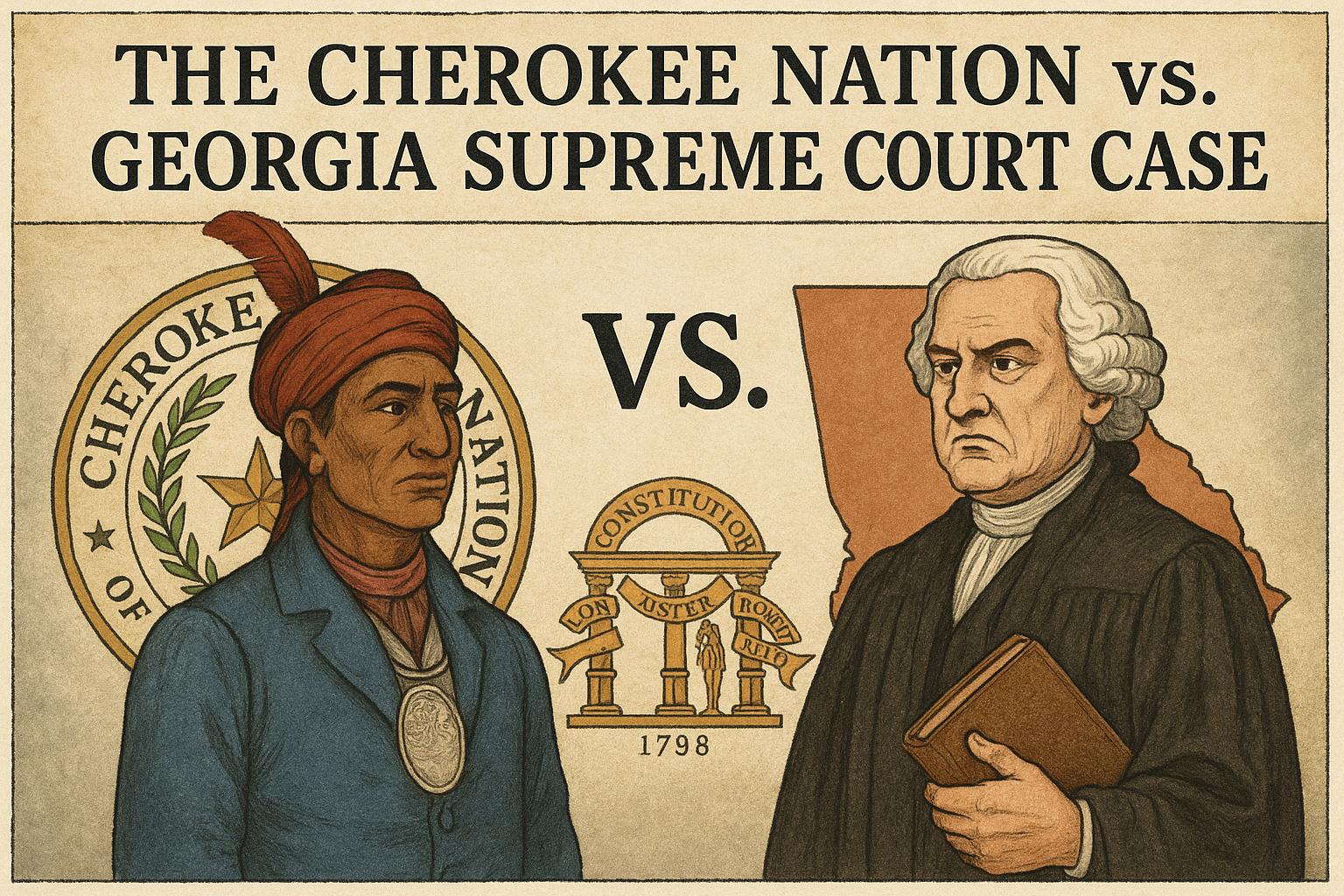
The Cherokee Nation vs. Georgia Supreme Court Case: An Overview
The Cherokee Nation vs. Georgia was a pivotal legal confrontation during the early 19th century, centered on the sovereignty and rights of the Cherokee Nation. This case emerged from ongoing disputes triggered by the state of Georgia’s policies aimed at exerting control over Cherokee territories. In response, the Cherokee Nation sought legal protection to maintain their territorial rights, culminating in a landmark decision by the U.S. Supreme Court.
Background
In the early 1800s, the Cherokee Nation faced mounting pressure from the U.S. government to relinquish their lands and relocate west of the Mississippi River. By the 1820s, Georgia aggressively pursued policies by enacting laws that extended its jurisdiction over Cherokee lands. The state actions blatantly disregarded prior treaties established between the U.S. federal government and the Cherokee Nation, which recognized the Cherokee’s territorial sovereignty.
Recognizing the escalating threat to their sovereignty and forced dispossession, the Cherokee Nation decided to legally challenge Georgia’s actions. Their pursuit was not only about retaining their traditional lands but also about asserting their rights as a sovereign entity in the face of overwhelming adversity. They resorted to the U.S. Supreme Court, seeking legal acknowledgment and protection of their sovereignty.
Legal Arguments
The Cherokee Nation appropriately filed a lawsuit with the U.S. Supreme Court, capitalizing on the Court’s original jurisdiction as outlined in Article III of the Constitution. The core of their legal argument hinged on the assertion that the Cherokee Nation functioned as a “foreign nation.” This classification, they contended, would permit them to initiate a suit against a U.S. state.
The question at the heart of the legal debate was whether the Cherokee Nation could indeed be classified as a sovereign entity possessing the inherent right to sue a state within the United States. For the Cherokee, achieving this recognition was crucial to protect their lands and sustain their self-governance against state encroachments.
Supreme Court Decision
In 1831, the U.S. Supreme Court delivered its decision on this case, with Chief Justice John Marshall articulating the ruling. The Court concluded that the Cherokee Nation did not qualify as a “foreign nation” under the Constitutional definition. Instead, it declared the Cherokee to be a “domestic dependent nation.”
This classification of the Cherokee Nation as a domestic dependent nation was significant. While acknowledging a form of limited sovereignty, it inherently restricted the Cherokee’s legal standing to sue Georgia in the U.S. Supreme Court. Consequently, the Court concluded it lacked jurisdiction, effectively denying the Cherokee Nation a direct legal avenue to challenge Georgia’s encroachments.
Impact and Aftermath
The ruling in Cherokee Nation vs. Georgia denied the Cherokee Nation certain legal avenues in their struggle for preserving their territorial and sovereign rights. Despite this, the case illuminated the complex and often tenuous relationship between Native American tribes and the United States federal government over issues of sovereignty and jurisdiction.
Moreover, the case laid critical groundwork for future legal battles concerning Native American rights. It set a judicial precedent that would influence subsequent cases, most notably Worcester vs. Georgia in 1832. In this latter case, the Supreme Court under Chief Justice Marshall ruled that Georgia’s laws did not apply within Cherokee territory, reinforcing the notion of Cherokee sovereignty. Nonetheless, the enforcement of such judicial rulings proved inconsistent and largely inadequate.
The broader implications of these rulings were profound. Despite a favorable outcome in Worcester vs. Georgia, the U.S. federal government ultimately persisted in enforcing policies geared towards Indian removal. This policy direction culminated horrifically in the forced relocation known as the Trail of Tears, marking a tragic chapter in American history.
The case of Cherokee Nation vs. Georgia remains an indispensable historical example. It underscores the legal challenges and systemic limitations that Native American tribes faced in asserting and protecting their rights within the U.S. legal framework throughout this era.